26
October 2026
Next club meeting Monday 2nd November 2026.
Will feature a talk by Christopher Gallacher on the
medallic portraits of Sir Winston Churchill (1987)*,
and some notes on exhibiting them (2024-2025). Christopher is a curator at
the Heberden Room in the Ashmolean Museum, Oxford.
Meetings are held
at the Abbey Baptist Church, Abbey Square, commencing at 7.00 p.m.
Notices:
We have several members who are receiving treatment for various serious
conditions – Peter (our President), Michael and Graham. The club gives its best
wishes to them, and hopes for speedy recovery and
looks forward to seeing them again in due course at future meetings.
The British Association of Numismatic Societies (BANS) has put out a
second call for delegates to their 2027 Congress, which will be held 9th
to 11 April 2027 at Ipswich, Suffolk. If any member is interested, I can give
them further details at the November meeting.
As ever the club committee also needs members. Please consider joining, as it
is not fair to leave the running of the club to the same small number of
members every year. If you are willing to
become a member of the committee, please notify one of the current committee,
members namely Henry, Tony and Jawaid or our VP John.
Membership cards are available from the Club Secretary
at the meeting for those who are paid up for the year 2026-2027.
October Meeting
Our meeting in October featured a
presentation by Arthur Satterley entitled Medals and Numismatics (How the
internet ruined everything). Arthur is an author and researcher in the
Orders and Medals Research Society (OMRS).
The speaker is a long-term collector and
researcher of medals, and in collaboration with fellow researcher Peter Lomdahl
has researched in depth the Naval General Service medal that was awarded to
participants in actions 1793-1840. The course of this research to attribute
medals to the correct recipient has taken them from naval listings to details
of medal metallurgy and construction and of the validity of medals offered,
where numismatics can be used to solve difficult issues.
The presentation commenced with reviewing
medals generally and a number of early specific battle
medals were issued in gold, silver etc according to rank, some by the East
India Company as well as by British navy and army. The first true campaign
medal was the Waterloo medal, with each awarded inscribed on the rim with the
recipient’s name and regiment. The Naval General Service medal was also
inscribed on the rim, and ribbon clasps recorded the major actions in which the
recipient took part. One of the first attribution issues found was clasps and
medals not matching.
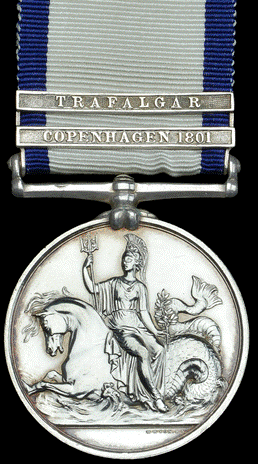
The medal to the right (The Naval General
Service war medal) was inscribed to William Reed. The first problem here was
identifying which William Reed of many of that name to which the medal had been
awarded? Fortunately, through the Captain’s Letter Book of HMS Bellerophon,
William Reed of Aberdeen was identified and described, and his rank (Ordinary
Seaman), position in the ship (Larboard Foretopsail watch), Lower Deck gun 10
and his age of 23 years.
These medals were made by Royal Mint under
the leadership of William Wyon.
However, the ribbon clasps were often changed
on these medals to falsify their history and to make them more valuable to
collectors.
The speaker then referred to the internet
in general and recent online genealogical websites allowing individual lives to
be traced – sometimes in great detail. Illustrated by
an article by the OMRS and a collage of Pen & Sword books (“…men behind the
medals”).
The first type of the Naval Long Service
& Good Conduct medal was issued in 1831 and each obverse of the was
engraved uniquely. But the same die was used for the body of the medal, and
over a period of 16 years that single die had cracked gradually becoming
progressively worse. The progress of the die crack could be tracked in medals
of 1831, 1833, 1837, 1844 and 1847 when the die was retired. The NLSGC medal
was then completely redesigned with the anchor reverse being replaced by that
of a ship.