24th
July 2026
August Summer social will be a visit to the replica Bayeux tapestry at
Reading Museum on Thursday 27th July. Meet
at the Museum 11:00 a.m. Please let the Club Secretary
know if you are coming.
This is a chance to
appreciate the tapestry without the costs (and crowds) associated with viewing
the original at the British Museum.
After the visit we
can explore local sites of interest, including a local hostelry for lunch.
Next club meeting Monday 7th September 2026.
A presentation by Tim
Millet
Meetings are held
at the Abbey Baptist Church, Abbey Square, commencing at 7.00 p.m.
Notices:
The club committee also needs members. Please consider joining, as it
is not fair to leave the running of the club to the same small number of
members every year. If you are willing to
become a member of the committee, please notify one of the current committee,
members namely Henry, Tony or Jawaid or our President Peter or VP John.
July Meeting
Paul Wood of Morton & Eden gave a talk
on the History of the Half-groat 1338-1662.
Paul commenced by saying that back in 1967
he had been a member of Reading Coin Club, and the first talk on coins that he
heard was at Reading Museum. He started working locally and subsequently in
London and other places, and then he joined Sotheby’s as a numismatic assistant
in 1978. In 2005 he started collecting medals, and later having sold his medal
collection, he commenced collecting half-groats.
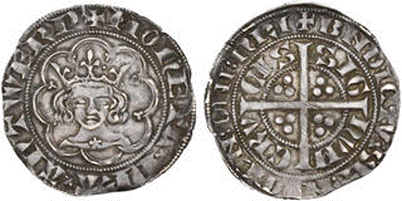
The history of the half-groat started with
the Antwerp demi-gros of the English type issued in 1338 by Edward III, whilst
he was staying in the city. Edward was in Antwerp raising funds for his war
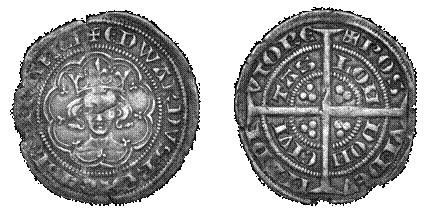
with France. The Antwerp half-groat was issued 13 years before the first
English type.
The style of the half-groat changed little
between 1351 and that of Henry VII’s in 1505. The monarchical titles of 1351 to
1361 claimed overlordship of France, but this Rex.Fr. was dropped in the period
1361- 1369 following the treaty of Bretigny in 1361 – but the title returned to
coins in issues after 1369.
Antwerp Demi-gross 1338 First English half-groat 1351 pre-Bretigny
treaty
From 1352 to 1355 half-groats were minted
at York. In 1363 the mint of Calais opened, the production of groats, half
groats and pence; however they were few compared to the gold, and all are rare.
The Calais mint continued operations until the 1440’s.
The Post Treaty silver of Edward III is
much scarcer than the other series of his reign, and most examples come from
the Coyningham Hoard in Essex.
Edward was succeeded in 1377 by Richard
II, and from whose reign there were several half-groat issues. The type 3 is
very rare, whereas the type 4 is more common. Richard was deposed and succeeded
by Henry IV in 1400, who issued both a heavy coinage early in his reign and a
light coinage from 1412. Within the heavy coinage attributed to Henry are mules
of the Edward III post-treaty obverse and Richard II reverse. Cons of Henry IV
are very rare; possibly because at the time the silver content was worth more
than the coin face value. The coins of Henry V and Henry VI are stylistically
similar and of variable quality. The Calais mint closed in 1440’s, with the
Rosette-Mascule type (1431-32) being prolific.
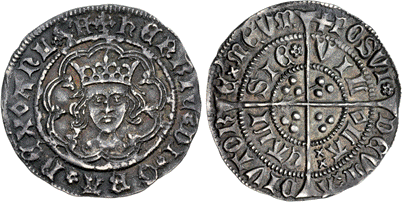
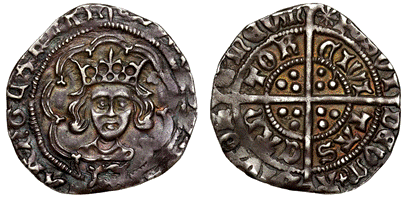
Rosette-Mascule half-groat Calais mint Edward IV 1st reign light coinage 1464-1470
` Archbishop of Canterbury’s mint
Edward IV coins of the light coinage are fairly common, while examples of the heavy coinage are much
rarer. Half-groats of this period were struck in London, Bristol, Canterbury
and York with a rare few made in Norwich and Coventry. Half-groats of Henry
VI’s restoration period (1470-1) are very rare with those known struck in
London and York. During the 2nd reign of Edward coins were struck at
Canterbury by both the King and the Archbishop. Moving on, the 25 known Richard
III half-groats were all struck in London, and are
generally of ropey quality.
The early half-groats of Henry VII are
stylistically very similar to those of the preceding reigns, and the first type
have reverses struck from dies of Richard III. Those issued in the 1490’s had a
modified full-face design of the usual type. However, from 1505 onwards
half-groats now carry realistic profile (or half-profile) obverses of the
reigning monarchs, and reverses are increasingly of appropriate royal heraldic
symbols, and finally losing the medieval cross by the end of the Tudor era.
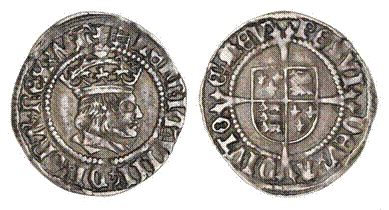
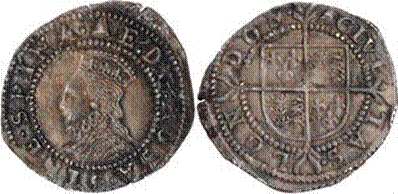
Henry VII
Profile issue 1505-09 Elizabeth 6th coinage 1583-1600 rare
trial
without mark of value on obverse
The early HenryVII type 3b coins of
1490-1504 are quite common, as are the later profile issues of his reign and
that of Henry VIII until the debased issues (old coppernose) of the third
coinage of1544-7. As an interesting side note Paul said that archbishoprics
were only permitted to mint coins up to a value of a groat; Archbishop Wolsey
struck groat coins, thus exceeding his remit and perhaps one factor in his fall
from royal grace.
The highly debased half-groats are
extremely rare. Those of the reign of Philip and Mary are distinguished by
having only Mary’s crowned portrait on the coin. During the reigns of Mary and
Elizabeth the quality of the silver coins was restored to intrinsic values.
There were seven issues of hammered half-groats during Elizabeth’s reign, and
examples of the third issue (1566-1571) without coronet mm are not uncommon. It
was during her reign that milled silver half-groats made an appearance
(1560-1574). By the end of the Tudor period minting coins had been largely
centralised under the crown.
The Stuart era saw half-groat issues of
James I, Charles I, Commonwealth and Charles II with the last hammered
half-groats series being issued in 1662.
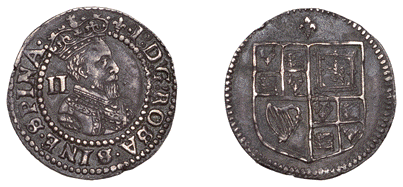
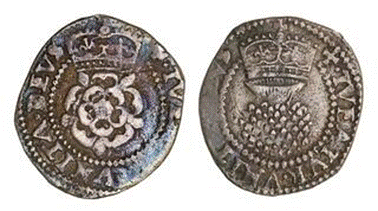
James I First coinage 1603-04 the only Later James I type (1604-25),
and also
portrait issue of his half-groat similar to Charles I first issue
The first issue from James I had a
portrait obverse, and shield reverse with thistle mm. This coin was quickly
superseded by the second and third issues with the rose obverse and thistle
reverse symbolises the union of the two national dynasties. Charles I
half-groats followed initially, similarly the James rose obverse and thistle
reverse save that the two emblems were intertwined on the two faces. In 1630
the half-groat again became a coin with a portrait obverse and a heraldic
reverse. It seems that this coin was very popular and good examples may be
obtained at modest prices.
The milled coinage of Nicholas Briot also had
portrait obverses and heraldic shield reverses although it appears that by the 1640’s
it was not so widely used.
Now the Stuart coinage enters the period
of the Wars of the Three Kingdoms, and many hammered half-groats are being
produced by a variety of regional mints. Some are of very high artistic quality
e.g. Aberystwyth and Bristol. Coins from other mints shown in the presentation
were Dovey and Oxford.
Following Charles, the Commonwealth’s
coinage was very simple and clear and the breeches half-groat was no exception.
The coin only remained for a short time after the restoration of Charles II with
the half-groat series ending in 1662, with the third issue hammered coin, which
is the commonest of his half-groats.
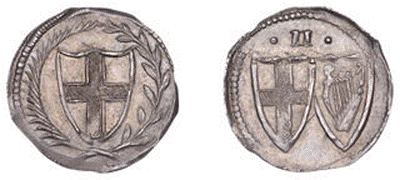
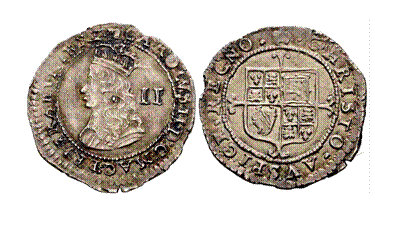
The 1649-1660 Commonwealth half-groat Third issue of Charles II with value
The club heartily applauded Paul’s
scholarly presentation and appreciated the many comments he made on scarcity
and guidance on prices of coins throughout his talk.
Prior to the meeting Paul very kindly had
sent the club secretary a dozen or more recent Morton & Eden auction
catalogues. Many of these were on display for members to read at their leisure
at or after the meeting. The remainder will be brought to the club at its next
meeting. Paul’s generosity is very much appreciated.
Future Events.
London
Coin Fair – Shortlands, London, W6 –5th September & 7th
November 2026
Midland
Coin Fair – National Motorcycle Museum - 9th August & 13th
September 2026
Noonans, Mayfair, W1J 8BQ –2nd-3rd,
8th, 16th-17th & 29th September 2026
Morton & Eden – October 2026
St James Auctions –23rd September 2026
Warwick & Warwick – 19th August &
21st October 2026
Past Events
50 years ago, Gavin Scott gave a
talk on “British Countermarks”.
40 years ago, in 1986 Nigel Mills
gave a talk about “Billingsgate Finds”.
30 years ago, Michael Broome
entertained us with a talk on “Frank Bowcher an English Medalist”.
20 years ago, the talk was on “East
India Coinage Outside India” by John Roberts-Lewis
10 years ago, Megan Gooch spoke on
the Tower Mint and organizing a coin exhibition at the Tower
Club Secretary