30th
April 2026
Next club meeting Monday 11th May 2026.
Subject – The Rise and Fall of the local Pound -A talk by Alastair
Mackay on local British paper currency
Monday 5th June 2026
·
Annual General Meeting and Display Competition
Monday 6th July 2026
·
English Half-groats 1321-1662 By Paul Woods
Meetings are held at the Abbey Baptist Church,
Abbey Square, commencing at 7.00 p.m.
Notices:
April Meeting
The April meeting began with ‘church
notices’ reporting on the continuing recovery from a fall by Gavin and a visit
to Graham, who continues to keep active, in both local church affairs and coin
dealing. We also heard about future talks for the club in July and September.
The talk for the evening concerned
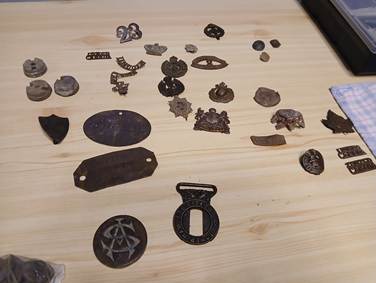
Military items found by metal detecting and was given by Roy Sellstrom. Roy
started collecting a variety of things at a young age and very soon specialised
in militaria. He pointed out that one thing he didn’t collect was coins! Roy is
from the Manchester area and he started with postcards
as they were cheapest. Having had a career in the military, including service
in the first Gulf war, Roy found that metal detecting was a therapeutic way to cope
with the strain of leaving the army. Whilst many of the finds he encountered
were not very interesting, he found the various badges and buttons and other
militaria fascinating. His personal theory as to why there are so many buttons
and badges to be found in farmer’s fields is that worn out military clothing
would be sold on and eventually end up being used by farmers to insulate their
winter crops. When the cloth biodegraded it left all the metalwork in place.
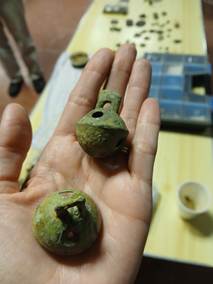
There are many types of buttons, from
plain lead two or four holed, to ornate buttons with intricate designs. There
are also many other military items to be found and Roy
showed us a picture of a field where a German Heinkel had crash-landed in 1940.
The pilot survived and was held up by an old man with a pistol, who was himself
subsequently arrested because he should’ve handed in his pistol and hadn’t.
England has been invaded many times over the centuries
and you can also find metal items as far back as the Roman invasion though the
original forts, which were all over Britain were made of wood which has since perished.
The army needed camps to carry out exercises and Aldershot (only the third
garrison town constructed since Roman times) was chosen in the 1850s, partly
because it was cheaper land. The typical uniform of this period was adorned
with badges, buttons and various other items, which have often survived, whilst
the material uniforms themselves have disintegrated, outside of those kept in
museums. In modern times this material has reduced to perhaps just a cap badge.
Cap badges from the Victorian ages were
based on the ‘Brunswick Star’ which was a badge with an interchangeable centre,
to represent different regiments. If one broke it would be disposed of in the
camp dump. Eventually when the camps disbanded the land would be returned to
farming and in the normal course of events the contents of the dump would be
spread throughout the field. Other badges included shoulder badges, one in particular the ‘Red Cross’ badge identified medical
staff. Roy said that all these items could be bought, but he was only
interested in the items found in the ground as he knew they would be genuine
and used in the period.
Other items that turn up are metal plates
that would go on foot lockers, which were used for soldier’s private items
which Roy illustrated with one for 13 Company of the 1st Grenadier
guards or for military supplies. Another item that Roy showed was from a
grenade, the famous Mills 36. He pointed out that successful as it was it was
not ideal, being too heavy. In contrast, German grenades had a wooden handle
allowing a flatter trajectory for throwing.
Roy showed a belt buckle from the Tower
Hamlets Rifles. It dated from about the 1840s when there was a perceived threat
from the French and lots of local groups sprung up which became the basis of
the Territorial Army which formed in 1908, and had nothing
to do with the regular army. This particular piece was
a gift from amongst his detectorist friends who regularly swap pieces that they
know particularly interest their friends. There are areas in our locale where
different nations soldiers had camps, including the Free French, Canadian and
other Commonwealth countries.
There then followed an array of buttons
from various regiments and various historical periods. Which regiment the
button belongs to can be identified by the number on the button, for example,
number one belongs to the ‘Pontius Pilates Bodyguard’ otherwise known as the
Royal Scots up to 110 which would have been one of the regiments from the East
India Company. Three buttons of particular interest included an officer’s one,
which would originally have been gilded from the Household Cavalry with ‘3D’ on
it for ‘Third dragoons’, second had ‘C D S’ which indicated it was for the
Cavalry training school and the third, with a Victorian crown, indicated one of
the officers who were teaching the cadets. And so, it continued with many more
buttons, each with a story to tell, and all intertwined as the various parts of
the army altered over the centuries. Some are very confusing, like a button
with three cannons on, which you would naturally associate with the artillery but which actually belongs
to the Royal Ordnance, who supplied things like cannonballs.
Further badges followed, with some from
the Worcestershire and Irish Guards, a collar badge from a Scottish regiment
and a cadet corps badge from the London Rifle Brigade. Next, we had Canadian
badges including one for the dental corps and one for the Railway corps. There
were also general service buttons, whose period can be determined by the Royal
crown on them. Larger buttons went on the jacket, smaller ones on the cuffs.
Two buttons with a single cannon on were from the Royal artillery and two
buttons, with crowns, turned out not to be military at all but were for a civil
servant of some sort.
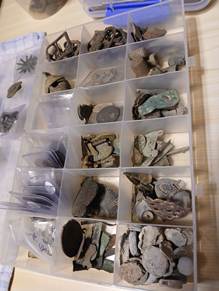
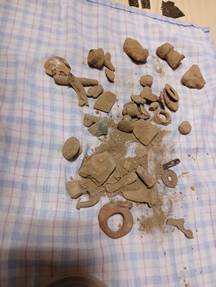
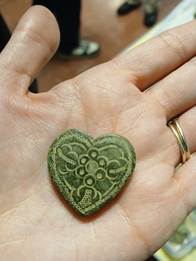
Roy then showed us his oldest find, a
sword hilt from the iron age. Roy didn’t realise what it was at first but luckily had it identified before it might have
been dismissed. He then gave us a very quick explanation of what constitutes
‘treasure’ and what doesn’t.
His talk was followed by a question-and-answer
session with topics like the difference between ‘bombardier’ and ‘grenadier’.
All infantry were trained in the use of grenades, the
light infantry was the rifle brigade and bombardier
was a rank in the light infantry. Also, it seems that many of the buttons would
have been manufactured in Birmingham and once there were many manufacturers but
today there are about six remaining. Canadian regiments that came over in WW1
all had badges for their respective provinces. This was too expensive to
continue in the UK so they were all issued with Maple
Leaf badges.
The club expressed its thanks to Roy for
an informative, well-illustrated and entertaining talk.
Thanks to Maria Lloyd for the images.
Future Events.
London
Coin Fair – Shortlands, London, W6 –13th June 2026
Noonans, Mayfair, W1J 8BQ – 13th
May 2026
Morton & Eden –Spring 2026
St James Auctions – 14th May 2026
Past Events
·
10 years ago – “Symbols on coins” – Tony Holmes
· 20 years ago – “Life
Saving Awards” - John Wilson
· 50 years ago – Member’s evening
Club Secretary