20th
October 2025
Next club meeting 1st November –
A talk by Arthur Sottley
on the Davison Trafalgar Medal.
Meetings are held at the Abbey Baptist
Church, Abbey Square, commencing at 7.00 p.m.
A Note from the Treasurer
The club subscription has been held at £20
for the coming year and subscriptions are due now! Please remit as soon as
possible.
Club membership cards can be collected at
the meeting.
Graham Kirby
Sadly, we have learned that Graham has
been diagnosed with a brain tumour. One consequence of this is that he is very
unlikely to be coming to the Club meetings anymore. He is currently at home and
‘making sure his affairs are in order’. Our best wishes go to him and Glen at this time.
On talking to Graham, he was very
insistent to thank everyone for all that he has benefitted from by being a
member (since 1969!). In fact, as a stalwart member of the club, it owes him
much more than he owes the club. He has been Chairman, given numerous lectures,
short talks, displays, joined in social events over the years and has been one
of the most important dealers attending our meetings.
His presence, friendship and expertise
will be greatly missed by all club members and we will
keep the membership informed of any more news over the next months.
October 2025 Meeting
On 6th October Dr Julian Baker
of the Ashmolean Museum, University of Oxford gave a talk on the Money in
Late Byzantine and medieval Albania and Epiros. Dr Baker is the Assistant
Keeper of Medieval and Modern Coins, Heberden Coin Room at the Ashmolean Museum.
Dr Baker introduced his talk with a brief
history of the region and its geography. The area known as Epiros encompassed
not only modern Albania but also parts of Montenegro and northern Greece, and extended further east than the current Albanian
border. In the early 13th century, the Despotate of Epirus extended
along the Adriatic coast from modern Dubrovnik to the Gulf of Patras, and stretched eastwards to the Aegean Sea. These
limits changed considerably during the late medieval period as did the rulers of
the area, and by the beginning of the 14th century the width of the
Despotate had shrunk to less than half of that a century before. By 1340 the
Despotate of Epiros had been completely absorbed by Serbia, and then in the
following century by the Ottoman Empire. There were some Venetian trading ports
and enclaves along the Adriatic coastline however.
In terms of currency little native coinage
was produced in the region as most coinage was imported from the dominant
economic powers of the time: the Byzantines in the east, and the Angevins and
Venetians from the west, and Serbians from the north.
Dr Baker then described various studies
and investigations taken in connection with hoards found in Albania,
particularly those by Prof Ljubica (1875), Theodore Ippen (1902), King Vittorio
Emmanuele III (various studies 1904 – 1943), Giuseppe Valentini (1939) and D M
Metcalfe more recently.
The hoards and their locations were
reviewed. Many of these locations are in somewhat remote places, while others
are constrained by archaeology or other sensitive locations. Dr Baker enumerated
and discussed some 15 hoards dated 1200-1400 AD that are housed in the
Institute of Archaeology, Tirana, and also a further 7
hoards in the same timespan that are housed elsewhere.
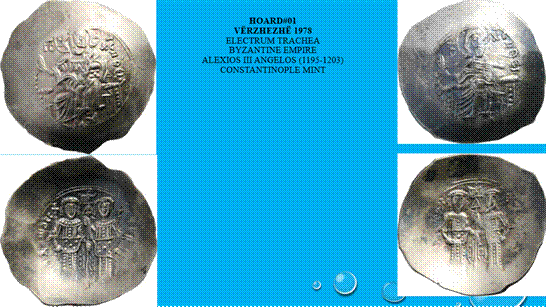
Hoard#01 –
Vërzhezhë 1978; Electrum Trachea ; Byzantine Empire
Alexios III Angelos (1195-1203) : Constantinople Mint
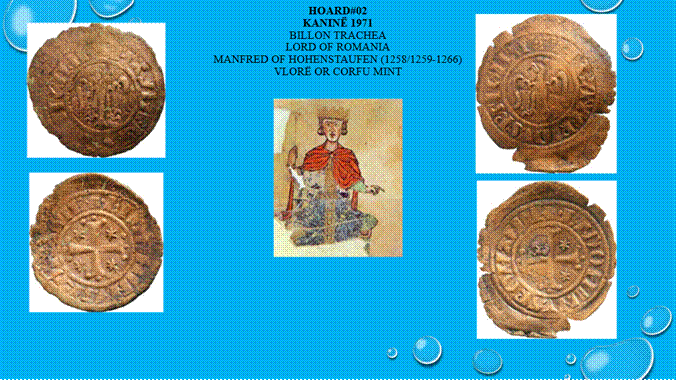
Hoard#02 -
Kaninë 1971; Billon Trachea; Lord of Romania
Manfred of Hohenstaufen (1258/1259-1266) : Vlorë or Corfu Mint
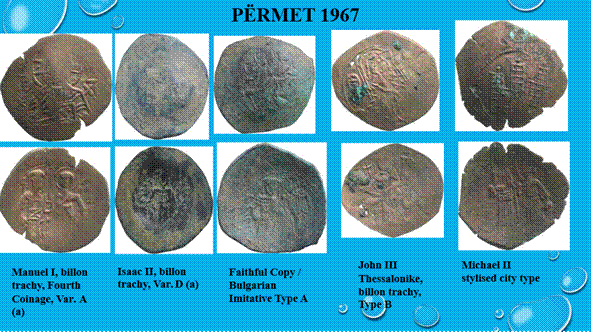
Miscellaneous Byzantine Coins from the Përmet hoard
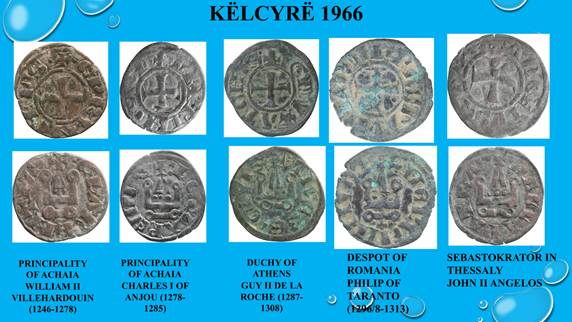
Miscellaneous
Angevine & Byzantine Coins from the Këlcyrë hoard
Various
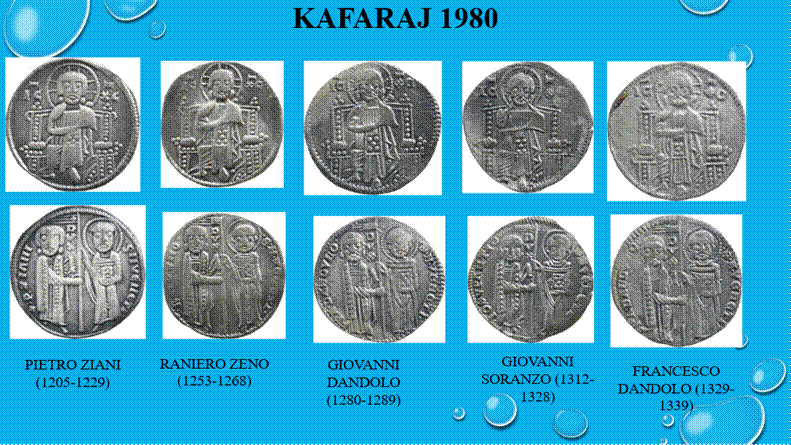
Venetian Coins from the Kafaraj hoard
Julian Baker took a
number of questions at the end of talk, and the club members showed
their appreciation of his scholarly presentation.
Future Events.
London
Coin Fair – Shortlands, London, W6 – 1st November 2025 & 7th
February 2026
Midland
Coin Fair - National Motorcycle Museum –9th November & 14th
December 2025
Spinks
Auctions –20th November & 10th December 2025
Noonans, Mayfair, W1J 8BQ –12th
November & 9th December 2025