20th
November 2025
Next club meeting 1st December –
Winter Bourse and Members Evening
Our club’s annual get-together enjoying
Henry’s buffet, the craic, the quiz and of course our own dealing bourse. So do
remember to bring along your coins that you wish to trade with other members.
The 5th
January meeting will be the annual short talks by members, competing for the
Marc Myhill Memorial Shield. The quiet week between Christmas and the New Year
is a good time to start thinking of talk topics (if not earlier)!
Meetings are held at the Abbey Baptist
Church, Abbey Square, commencing at 7.00 p.m.
A Note from the Treasurer
The club subscription has been held at £20
for the coming year and subscriptions are due now! Please remit as soon as
possible.
Club membership cards can be collected at
the meeting.
November 2025 Meeting
Arthur Sottley gave a lengthy and
informative presentation on Alexander Davison’s Trafalgar Medal, and Nelson’s
funeral.
Commencing his talk Arthur acknowledged
his collaborators; Sim Comfort who specialised in the Naval medals of Matthew
Boulton; Martyn Downer, a former director of Sotheby’s; and Philip Attwood,
retired curator of coins and medals at the British Museum. He also referenced
the work of Susan Amos on the state funeral of Nelson in 1806.
By the time of the Battle of the Nile in
1798 Nelson was already a national hero.
Alexander Davison was a business
man and supply contractor for the British Government, and a prize agent
who was also a friend of Admiral Nelson. Davison was responsible for several
acts that glorified Nelson's public image. These included the creation of a
medal commemorating the victory at the Battle of the Nile (from which Davison
profited as Nelson’s prize agent).
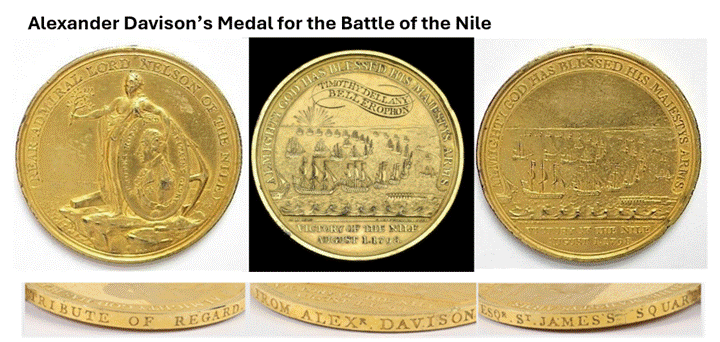
The medal was minted in gold for Nelson
and his captains, in silver for junior officers, in gilt bronze for petty
officers and bronze for other ranks. They did not have suspension loops.
Nelson’s victory at Trafalgar over the
combined French and Spanish fleets was of profound relief to the nation, which
standing without effective allies, had been under the very real threat of
invasion by Napoleon’s armies. Trafalgar completed negated any chance of a seaborne
invasion of Britain.
To commemorate this important victory
Matthew Boulton issued approximately 15,000 medals in total, in gold, silver,
white metal, gilt bronze and bronze, and these were originally issued without
suspension. The issue of the medals was delayed because of a difference with
Lady Hamilton over the portrait of Nelson.
Many recipients engraved the reverse of
the medal with their names and ships (see below)
Mathew Boulton’s Trafalgar Medal
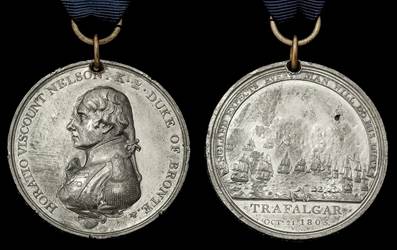
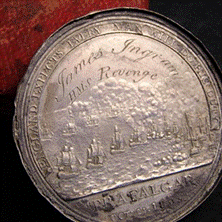
Below is the Trafalgar medal attributed to
Davison:
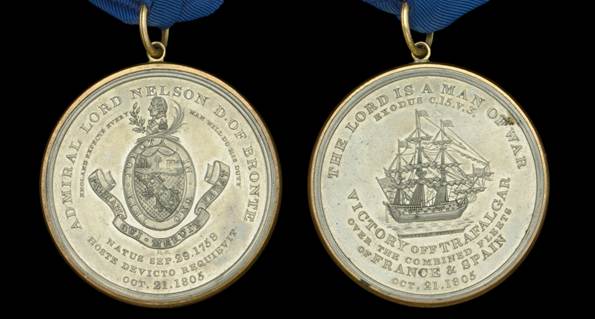
However, there is no record of this medal being
struck by Matthew Boulton nor of any order by Davison. Exhaustive research
suggests that the dies for this medal were cut by Thomas Halliday, a former
apprentice of Boulton, and were struck at Halliday’s own mint in Birmingham. About
300 of these medals were struck and were given to men that served on HMS
Victory at the battle. Certainly, they were given to the 48 ratings and 12
marines who took part in Nelson’s funeral procession of 9th January
1806.
It is suggested that this medal should be
renamed “Halliday’s Badge of Distinction”.
A photograph of Greenwich pensioner James
Sharmen, ex-HMS Victory veteran, shows him wearing the Matthew Boulton medal,
the Halliday medal and the Naval General Service Medal. The latter medal was retrospectively
issued between 1847 and 1851 for those who served in the navy between 1793 and
1840.
Nelson’s funeral was a most elaborate
affair, as appropriate for the nation’s hero. After Trafalgar (21 October 1805)
it took many weeks for his body to reach Greenwich, finally arriving there on
24th December. His body lay in state from the 5th to the 7th January. It was on that latter day that 48
ratings and 12 marines from HMS Victory arrived at Greenwich, and these men would
accompany the coffin to the Admiralty, Whitehall, by river on the State Barge
the following day.
The river procession was a spectacular event in itself. The special uniforms worn by the Victory
men for the occasion led to the adoption this clothing as the later general naval
uniform. Prior to this there were no official uniforms for other ranks.
The sixty men from the Victory, bearing
the ships ensign, were also in the procession from the Admiralty to St Paul’s
Cathedral, and were allotted places close to the coffin at the cathedral. Each
man was reported in the press as wearing a badge of distinction (Halliday’s
medal shown above).
As the coffin was being lowered into the
crypt the men of the Victory fell on the flag covering the coffin and took
pieces of it as mementoes of he
occasion.
The funeral arrangements were largely the
work of two men. One was Sir Isaac Heard, Garter King of Arms and the other Ange
Denis Macquin, Professor of Classics and the Arts. The arrangements they made
have formed the basis of all subsequent British state funerals.
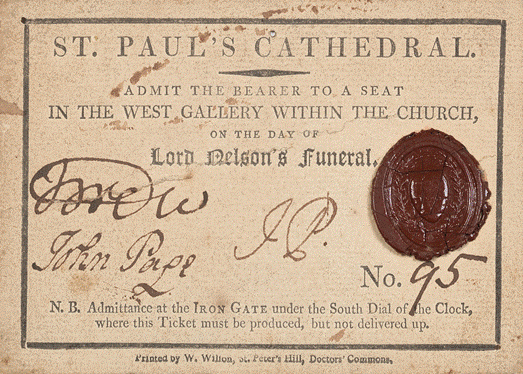
All admissions to St Paul’s were by ticket only – for example as above
Arthur Sottley’s presentation was heartily
received by the club.
The support of OMRS – the Orders and
Medals Research Society – in the presentation material is acknowledged.
Future Events.
London
Coin Fair – Shortlands, London, W6 –7th February 2026
Midland
Coin Fair - National Motorcycle Museum –14th December 2025 &
11Jan 2026
Spinks
Auctions –10th December 2025
Noonans, Mayfair, W1J 8BQ –10
&11th December 2025; 14 & 27th January
2026
Morton & Eden – February 2026
St James Auctions –4th December 2025
Baldwins –9th December 2025
Past
Events
In 2015
Peter Hall spoke on “The Death of Commodus (AD192) - the aftermath: in Britain
and the Roman Empire”.
In 2005
Julian Baker described the Portable Antiquities Scheme
The
club auction was held in 1995
In 1985
we had a talk on the excavations at Silchester.
In 1975
the club auction took place
Club
Secretary