2010 Display Competition for the
Michael Broome Memorial Cup
The annual display competition attracted five entries of a very commendable standard.
The competition entries, introduced with a few words from the exhibitors, were, as follows:
'The Development of Coinage.' Gavin
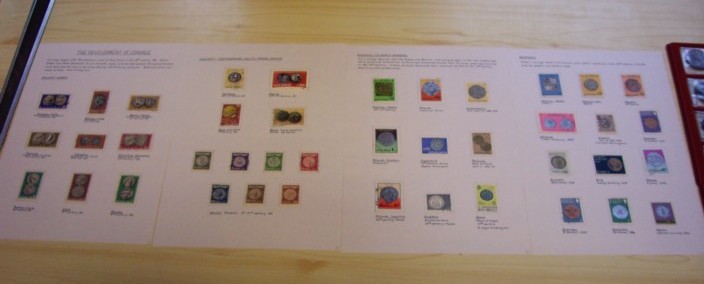 Gavin Scott prepared a display on "The Development of Coinage"
illustrated by 40 world postage stamps. This showed how coinage developed in Ancient Greece through Carthaginian,
Celtic and Roman periods to Jewish shekels and medieval and modern world coins. He pointed out this was rather
cheaper than collecting the real thing!"
Gavin Scott prepared a display on "The Development of Coinage"
illustrated by 40 world postage stamps. This showed how coinage developed in Ancient Greece through Carthaginian,
Celtic and Roman periods to Jewish shekels and medieval and modern world coins. He pointed out this was rather
cheaper than collecting the real thing!"
'Co-Operative Society Tokens' Neil
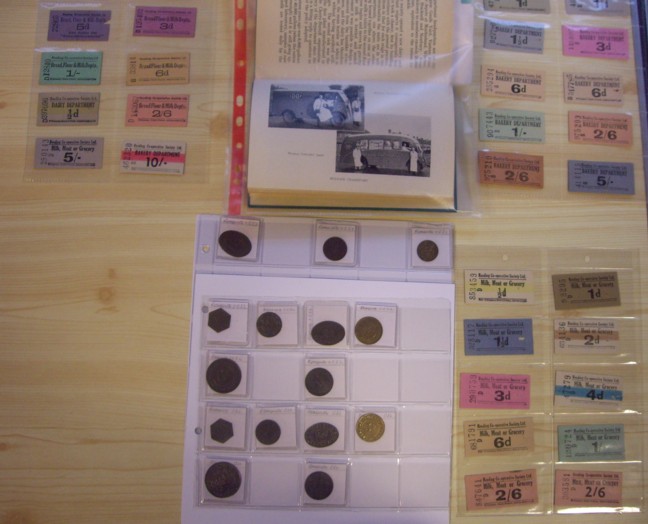 Neil’s display was Reading Co-operative Society bracteate
tinned iron and brass dividend checks issued from 1860 onwards.
Neil’s display was Reading Co-operative Society bracteate
tinned iron and brass dividend checks issued from 1860 onwards.
He also showed printed card dividend checks issued by the society in the 1920s for distribution
at their mobile shops; these colourful checks continued in use until the 1960s. A photograph
from the 1949 “Cooperation in the Thames Valley” shows one of these vehicles.
All of the display collection came from Roy Rains, author of “The Catalogue of Cooperative Tokens and Checks”
A collection of Charles I Hammered Halfcrowns by Maurice
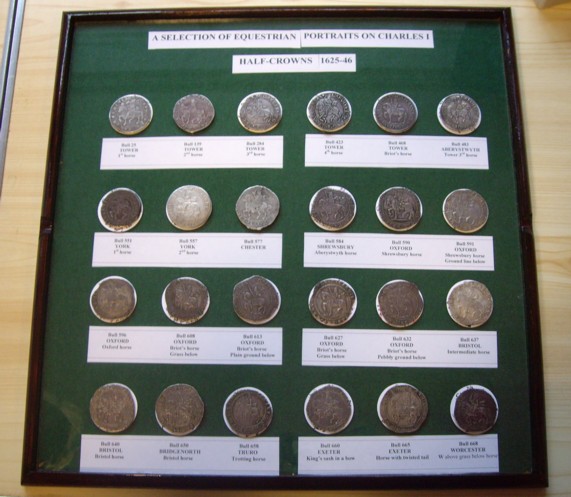 This display shows some of the different horsemen
(there are many more), in better than average grades.
Milled coins are relatively easily graded and their rarity well known but it takes an experienced eye to
appreciate hammered coins. Understanding how and where they were made is essential. Dies were individually
made (unlike today). The obverse die, with a pointed spike, was positioned in a block of wood, then a
roundish blank piece of metal, called a flan, which had been hammered into shape and thickness and then
cut with large shears to the desired weight, was then placed on top. The reverse die was held in the hand
and positioned on top of the flan then struck with a hammer, often many times if necessary; the moneyer
may not have placed the die correctly or the flan may have been uneven. Tower Mint employees were paid piece-work,
so they were not interested in the aesthetic look of the coins only the quantity they could produce.
This display shows some of the different horsemen
(there are many more), in better than average grades.
Milled coins are relatively easily graded and their rarity well known but it takes an experienced eye to
appreciate hammered coins. Understanding how and where they were made is essential. Dies were individually
made (unlike today). The obverse die, with a pointed spike, was positioned in a block of wood, then a
roundish blank piece of metal, called a flan, which had been hammered into shape and thickness and then
cut with large shears to the desired weight, was then placed on top. The reverse die was held in the hand
and positioned on top of the flan then struck with a hammer, often many times if necessary; the moneyer
may not have placed the die correctly or the flan may have been uneven. Tower Mint employees were paid piece-work,
so they were not interested in the aesthetic look of the coins only the quantity they could produce.
Each moneyer selected the best two coins per shift and placed them in a box to be tested for fineness
and weight at an annual ‘Trial of the Pyx'. Provincial Mints were never subjected to a Pyx Trial. In the
past, the public were able to take bullion (Silver plate, foreign coin etc) to the mint and have it coined.
The mint paid 60 shillings per troy pound for silver from which it produced 62 shillings. If the mint had
stocks it would pay out there and then, otherwise the people had to come back later. So long as a batch of
coins weighed the correct amount, they were allowed to be put into circulation, some would be over and others
under-weight. In other words as long as Joe public received his 62 shillings in exchange for one troy
pound of silver, the intrinsic value of each individual coin was unimportant.
It was common practice to cull over-weight specimens and either to sell them to collectors at a premium,
or to melt them down for a profit. As a result, today, most coins found are usually under the standard weight
(2/6 = 232.25 grains, 15.05 grammes) even allowing for wear.
Most hammered coins circulated a great deal, and high grade specimens are rare. Tower issues are relatively
common today, as they were struck in large quantities. As I have mentioned in my book, the reason so many
provincial coins have survived, in spite of very low mintages, is down to contemporary collectors who
found them fascinating.
Considering hammered coins were demonetised 1 st February 1697 and in the great re-coinage of 1816, all
milled coins were called in and melted down and re-struck in lower weights and sizes, it is amazing how
many hammered coins have survived!
Had it not been for rich people in the past who could afford to keep these de-monetised coins, this hobby
would not be so exciting.
Grading and valuing hammered coins depends on a number of things;
- Firstly, ‘Eye appeal’,
- Secondly, the amount of important detail visible (mint marks etc)
- Thirdly the particular obverse and reverse types
- Fourthly, the specific mint; some provincial mint coins, for example, may be so rare that grades become
almost immaterial
Those of you who specialise in a series soon learn to know the rarities and grades to expect, and accept
one has to pay a premium for them. One example in this display is my Chester coin. To the uninitiated it
may look awful and not worth the money I had to pay for it (I will not say, other than it was a four
figure sum) but it is not only a rare type from a very rare mint, but one I never expected to own.
'O'Clock' Graham
Bankers Mark
Counter Marks
Fantasy and Forgery
Helping Hand by patent
Just add a nought or a leg
Languages
Love Tokens
Mint Marks
Braille and Morse Code
Sources of silver
Trench Art
Two Heads are better than one
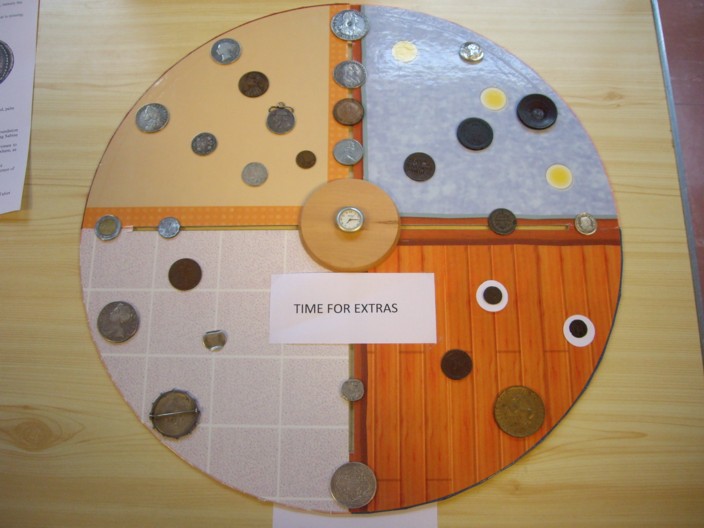
TIME FOR EXTRAS
- 1 o'clock: Added Bankers Mark, Athenian Tetradrachm 393-300BC On Athena's cheek is a banker's counter stamp to
show verification 'as passed through my hands.'- His mark would have been well known at the time.
of more advanced style, the eye seen in true profile; she wears crested helmet ornamented with
three olive-leaves and floral scroll. Rev. Owl [The Little Owl] standing right, head facing; to right A 6E ;
to left olive twig and crescent; all within incuse square (which soon disappears as the series progresses)
References BMC11,144. GC V 2537. cI7.0 gins [EubeiclAttic standard was 17.20 for a Tetradrachm and 4.30g for a
Drachm. Fine, this specimen - an early example, has the usual test cuts, but unusually, also has a bankers counter
stamp on the cheek ofAthena. (6A) i.e. Test cuts were generally made by traders in countries such as Egypt and those
in the Near East where the coins were treated as bullion.
- 2 O' Clock: Counter Marks: 40 Reis Brazil 1832 (Countermarked) Mintmark `R' for Rio de Janeiro. coin F Countermark GF
In this country Tokens such as Lloyds Weekly Newspaper 3d Post Free on a Cartwheel Penny and
MAYS WASHING POWDER on a French 5 Cents.
- 3 O' Clock Fantasy and Forgery-extra to the coin stock an Edward VIll Fantasy piece & a brass
forgery of Bank of England Token.
- 4 O' Clock A helping hand from private enterprise: The original lucrative Harrington patent to produce light weight
1/4d tokens was in essence an early example of a public/private partnership. The Patent was sold to the Duke of Lennox
and on his death in 1624, it became the property of his widow, the Dutchess of Richmond. Lord Maltravers obtained it in
1634.The two examples are contemporary copies of the latter two [vf Ref 32XX: & Maltravers 1/4d Token
Type 3 Counterfeit 1634-36 mm am fitchee on ow a rev. Ref S3199A NVF]
- 5 O' Clock Just add a nought... or a leg. 10,000 Mark German Notgeld,1923 a reminder that inflation
is never far away and an extra leg won't help us to escape it. [44mmObv. WinilterVom Stein Deutlchlnnds
Suhrer in Lchwererzeit 1757-1831 Rev. Horse rearing left Leg NOTGELD Der Provinz Weltfnlen 1923. Gilt Bronze] Isle of
Man 17981/2d
- 6 O' Clock Extra Languages quoted on a British Trade Dollar to facilitate trade in Far East. Value
stated in English, Chinese and Malay. India: Silver rupee of Kashmir - Gulab Singh "struck in
1846. Bearing the initials IHS Christian symbolism appearing on this coin of a non-christian ruler as a Talisman
to ensure lasting success in his undertakings. One day Gulab Singh was sitting with the British resident, Sir
Henry Lawrence. The latter, as usual, was busy with numerous papers and was not giving his friend his undivided attention.
Presently Gulob Singh asked Lawrence "Why is it that in the end the English ahvays conquer, even though at first all
goes against them?" Lawrence, busy and preoccupied, reached over to a piece of paper and wrote the letters I H S
These letters stand for JESUS HOMINIUM SALVATOR (Jesus, the Saviour of men) although they were originally I.H.C the
first three letters of the name of Jesus in Greek. Gulab Singh pondered deeply over this and ultimately decided that
the letters were some form of magic that brought power and victory to those who use them. When his next coins were
issued he had the magic letters stamped in the centre of the reverse in the hope they would ensure lasting success
in all his undertakings.
- 7 O' Clock Love Tokens: His initials carved on the back of a crown mounted as a brooch for her to wear. The crooked 6d is
definitely in a crooked style!
- 8 O' Clock Mint Marks: `E' for Edinburgh on the Queen Anne Crown, KN for King's Norton Metal Company in a more recent century.
- 9 O' Clock Braille & Morse Code: Noteworthy ideas - We have yet to copy Italy with her 500 Lire piece: The Canadian 5 cents
of 1944 V for Victory design with the Torch of Freedom. Morse code around says, `We win when we work willingly.'
- 10 O' Clock Source of silver: LIMA- Nicked off the Spanish from a large treasure galleon by Admiral Anson. Returning to the
port of London in 1744 with specie worth £500,000, a treasure so vast it filled 32 wagons.
Roses - silver sourced from mines in the west of England South Sea Company certainly had new angles! 1723
- 11 O' Clock Trench Art: Fun additions to any collection, evidence of how soldiers whiled away the hours in the trenches.
Pipe & heart, Victoria as a Jockey, Hat & Pipe, lady & dog.
- 12 O' Clock We have reached 12 O'Clock: Two heads are better than one! The George III Countermarked Dollar 1760-1820 on 8 Reals
of Charles IV dated 1792 of Mexico Mint. Owing to the scarcity of silver at the end of the 18th century Spanish Dollars
and halves were made legal tender in 1797. The Goldsmiths Company stamp was used- a small oval stamp with the king's head.
The value of this token dollar was 419d giving rise to the slogan "Two king's heads
not worth a crown." [Both the Dollar and the countermark were extensively forged and so in 1804 an Octagonal
countermark was used The same year as all official issue of bank of England Dollars was nude. Coil GF countermark
VF. Ref 53785A]
A bonus when two monarchs appear- William and Mary-2/6d 1689 2nd reverse Caul only frosted
pearls. Ref. S3435
By chance we also have two double headed coins. Collecting and investing in Coins - we're double winners every time!
'James I Gun-money.' Barry
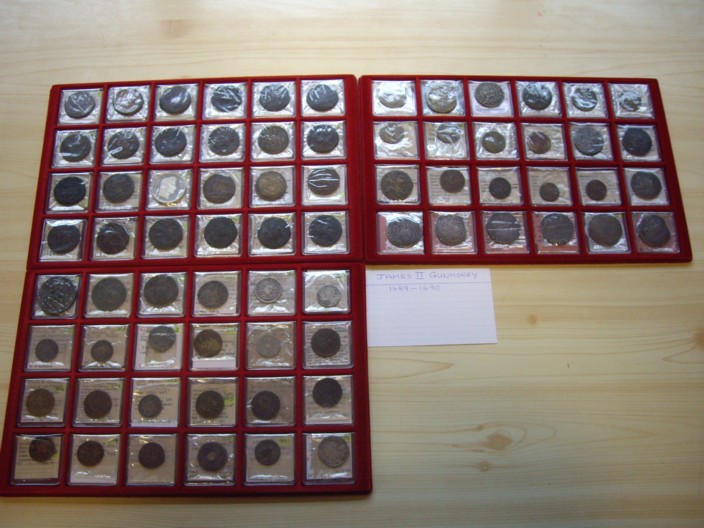 A good range of James I Gun-money coinage including a unique Crown
'A selection of George II and George III Shillings' Jawaid
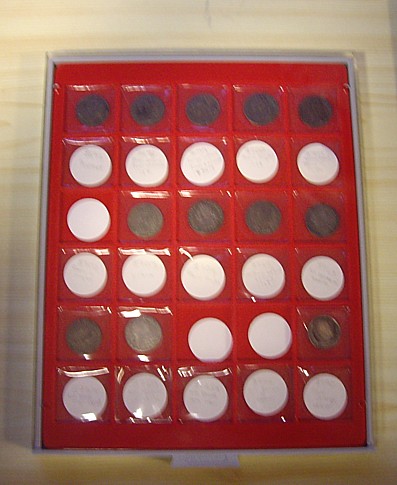 Jawaid had brought along some of his collection, some acquired
recently.
Jawaid had brought along some of his collection, some acquired
recently.
The standard of all five displays was very good and a credit to the entrants.
However, with more than 50% of the vote, the winner of the M Broome trophy was Maurice.
Well done.