Short Notes on the Life of Adam Clarke 1762(?) -1832
Adam Clarke was the greatest name in Methodism in the generation which succeeded Wesley.
- Three times president of the Methodist Conference
- Throughout his long and distinguished career it was ever the proudest boast of Adam Clarke that he was a Methodist Preacher.
It was even recorded on his dog tag as we have seen!
National Biography records:
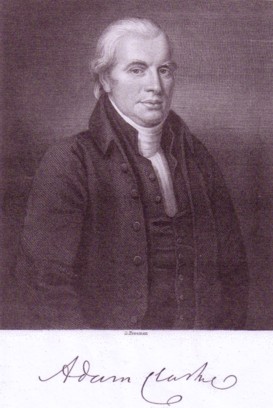 `A Theologian, educated at Kingswood School near Bristol; A Methodist, 1778; preacher on the Wiltshire circuit, 1782;
lived near London from 1805; LL.D, Aberdeen, 1808; published bibliographical works (The Wesley Family), 1803-6, and a
scripture commentary, 1810-26; began to edit Rymer's Foedera, 1818, his miscellaneous works printed (1836)'
`A Theologian, educated at Kingswood School near Bristol; A Methodist, 1778; preacher on the Wiltshire circuit, 1782;
lived near London from 1805; LL.D, Aberdeen, 1808; published bibliographical works (The Wesley Family), 1803-6, and a
scripture commentary, 1810-26; began to edit Rymer's Foedera, 1818, his miscellaneous works printed (1836)'
He delighted in the study of nature and astronomy, mineralogy and conchology.
He issued a sharp diatribe against
the use of tobacco which ended with the familiar extract from King James Counterblast to Tobacco
`It is a custom loathsome to the eye, hateful to the nose, harmful to the brain, dangerous to the lungs, and in
the black stinking fume thereof nearest resembling the horrible Stygian smoke of the pit that is bottomless.'
- He once said, `for my own part I can build a haystack or a chimney piece; mend my own shoes; pur sleeves into my own coat,
repair a frying pan, put bars to a gridiron and turn a lathe.'
- His articles included: The inscription on Arthur's tombstone. A miraculous growth of hair. Thoughts on dancing.
- He was a linguist speaking 20 languages.
- He possessed one of the finest private collections of books and manuscripts in the Kingdom and eagerly studied all the catalogues of book-sellers.
His independent judgements included:
- Judas would be saved.
- The so-called serpent who tempted Eve was a baboon.
It excited laughter, ridicule, disbelief and amongst his friends, genuine astonishment.
One paper published a poem called `Lines on the Nachash of Dr Adam Clarke'
`The Rev. Dr. Adam Clarke asserts
It could not be a serpent tempted Eve
But a gay monkey whose mimic arts
And fopperies were most likely to deceive.
Dogmatic commentators still hold out.
A serpent not a monkey tempted Madam;
And which shall we believe? Without a doubt
None knows so well who tempted Eve - as Adam.'
Other Notes:
- Luke 1:35 refused to accept Christ's filial relationship to the father. (P34)
- Began to edit Rymer 's Foedera, 1818 (P35) His work in effect was to make a supplement. The work was to collect
from all the archives of the United Kingdom, all authentic State papers from the conquest to the accession of George III;
to arrange and illustrate them infrequent reports to the Right Hon. His Majesties Commissioners on the public records of
the kingdom for the purpose of completing and continuing that collection of State papers called Rymer's Foedera of which
I have carried nearly four volumes folio through the press. Many have endeavoured to carp at the work but their teeth
were broken in their attempt to gnaw the file. To God only wise, be glory and dominion by Christ Jesus, for ever and ever. Amen.
To the end of his days he was a learner. Writing to a young friend he said, `study yourself half to death, and pray yourself
wholly to life. Do something you can look at, something that will be worth having when you are not worth a rush. P36/7...
He had not the tireless missionary zeal of Coke, nor the statesmanship of Jabez Bunting. He had not the sparkling eloquence
of Samuel Bradburn, nor the theological acumen of Richard Watson, but in combination of gifts he surpassed them all.
He was not only the greatest scholar in Methodism, but among the greatest of his age. The eminent Robert Hall pronounced
him `an ocean of learning' and William Jones, a famous Baptist minister and scholar, said: `He was unquestionably the
most universal scholar of his age.' After his death the conference of 1833 declared that the range of his learning, was
far beyond the standard even off those who have attained considerable rank among men of learning and research.' It asserted
further that `he was highly distinguished for his extraordinary attainments in Oriental literature and that his writings have
added largely to the valuable literary and Biblical stores of the country.' But if to all men he was known as a scholar, to
his own people he was a father in God and a brother beloved. It was due to him as much as to any man that Methodism passed
safely through the troubled years after Wesley's death and became in the 19th century a great Church, known and respected by
Christians of all communions.
David McNicoll said, `He would neither tread on an insect nor crouch to an Emperor'
Adam Clarke wrote the following poem in a lady's album.
`I have enjoyed the spring of life;
I have endured the toils of summer;
I have culled the fruits of autumn;
I am passing through the rigours of winter;
And am neither forsaken by God Not abandoned by man.
I see at no great distance the dawn of another day,
The first of a spring that shall be eternal;
It is advancing to meet me - I haste to embrace it:
Welcome! Welcome! Eternal Spring! Hallelujah!'
Adam Clarke by Maldwyn L/ Edwards AIM Ph.D. The Wesley Historical Society lectures No. 8