2005 Display Competition for the
Michael Broome Memorial Cup
There were four entries
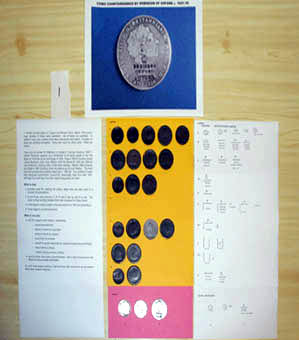
'The Countermarks of James Robinson' Gavin
Gavin's display consisted of many coins carrying the circular countermarks of Robinson Cutler Oxford, applied some time between 1825 and 1850. The coins were mostly copper with just a few silver 2/6d and a very rare 5/-. The countermarks were made from punches to mark wares and come in 2 basic varieties. They are not particularly rare so they must have had a purpose. Possibilities include crude advertisement, discount checks for customers or workers, truck tickets, receipts for goods under repair, trade tokens, (unlikely) or workers fun pieces, (unlikely). While before 1853 it was not an offence to mark copper coin the same was not true for silver. So why did Robinson apply his name to silver and risk prosecution?
'Be Entertained' Graham
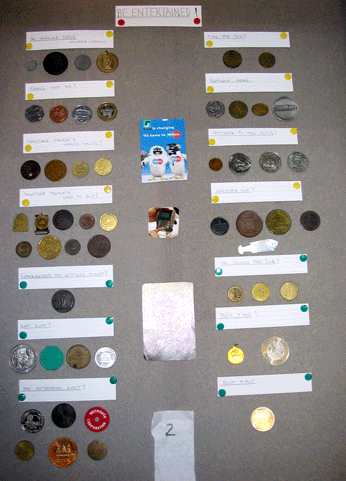
Following a day out and seeing a medallion celebrating 100 years of railway catering Graham began to think of all the pieces he had related to a day out. Hence his display consisted of various tickets, tokens advertisements and medallions that could be associated with a day out. We had the morning paper, travelling to the shop for retail therapy, what to buy and eating out. Then a visit to an attraction followed by time tea or maybe coffee. Returning home it is attend to the pets before an evening out of gambling, cards or maybe a circus. Then, to finish the day, a drink at the pub or ghastly cocoa, before retiring for the night.
'The Influence of Thomas Bushell on the Coinage of Charles I' Maurice
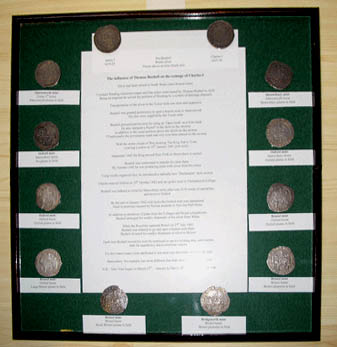
By the 1600's the silver mines of Wales were mostly unworkable due to flooding. Mr Bushell invested heavily and managed to drain the mines to retrieve more silver. After many pleas to the crown Bushell was allowed to open a mint at Aberystwyth, thus saving on the high transport costs of hauling the silver to and from the Tower. Two conditions were imposed, namely he finance the whole operation and the dies be supplied from the tower. However, as the Civil War progressed Charles lost control of the Tower and was forced to establish mints elsewhere. As the fortunes of King Charles waned so he was forced to move his hastily established mints from stronghold to stronghold. Also as dies were no longer available from the tower, and being expensive to produce, there was little choice but to reuse old dies whenever possible. Thus as a mint closed, so the dies were dispatched to the new location, and either repaired or modified so that they could be used again. Maurice's display consisted of examples of halfcrowns produced from these roving dies, starting at Aberystwyth to Shrewsbury to Oxford to Bristol and finally to Bridgenorth, each example showing the salient distinguishing features.
'Tokens and Medallions Illustrated' David
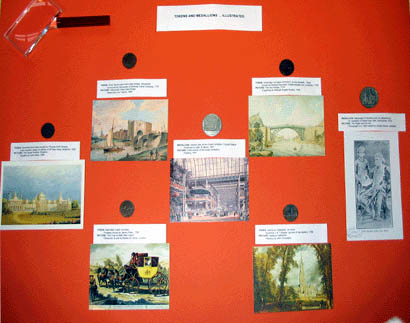
David's display consisted of several coins and medallions together with an associated picture where the scene on each was almost identical. It is fairly easy to find graphic material of scenes depicted on numismatica but to find contemporary material, as incorporated in the display, is rather more difficult. The subject matter covered included Iron Bridge at Coalbrookdale, the Great Exhibition, the Brighton Pavilion, and Salisbury Cathedral. More striking was picture of the Gloucester West Gate Bridge on the river Severn painted in 1806 which was absolutely identical to the scene depicted on the Gloucester & Berkley coal company token of 1797. Another identical match was the medallion of the Maharaja of Benaries dated 1872. The obverse has the Maharaja with his adopted son and the reverse is of Stoke Row well. What is clear is that the obverse is taken directly from the picture published in 1864, as the depictions are identical.
All of the presenters gave a five minutes talk on their display.
The competition was tied between David and Graham who get to share the Michael Broome Memorial Cup for one year.
Well done .